

The FirstOrg Content Engine

A Full Content Team.
None of Your Hours.

FirstOrg plans, writes, and publishes for your company every day — strategy to post, in your voice. The only step it saves for you is approval.

The #1 enemy of consistent and quality content is the founder's calendar.

One Loop.
Always Running.

Strategy, calendar, writing, publishing — the engine runs every stage on its own, seven days a week, and results feed back in so next week's plan is sharper than this one's. You approve; it ships.

See the workflow we run on ourselves
The FirstOrg content loop Four stages connected in a cycle: Strategy sets pillars and topics from your goals; Calendar turns them into a cadence tuned to your buyers; Write drafts every post in your voice; you approve — or grant trusted channels autonomy — and Publish ships on schedule. Results feed back into Strategy, so the loop never stops. results feed back Strategy Pillars & topics from your goals Calendar A cadence tuned to your buyers Write Every post in your voice Publish Ships on schedule You approve here or grant trusted channels autonomy

Running this loop by hand is a full-time job — here's what the DIY version takes →

Strategy Reads your profile and goals, then sets the pillars and topics you'll own — built in, below.
Calendar Turns the plan into a posting cadence tuned to your buyers.
Write Drafts every post in your voice — the LinkedIn → and Search → specialists.
Publish Ships to your channels on schedule, or waits for your nod — you set the terms →
7 days a week it plans, writes, and publishes — your pipeline never goes quiet.
1 approval step — yours. Review every post, or let trusted channels run on their own.
0 briefs, blank pages, or Sunday-night scrambles left on your plate.

Your Strategy.
Built In, Not Bolted On.

Before a single post is drafted, the engine studies three inputs — your profile, your market, and what competitors already say — and turns them into the pillars, topics, and cadence you'll own. Your buyers are already telling you what to write; the strategy listens.

Where the topics come from
How your strategy is built Three inputs — your profile, market research, and a competitor scan — feed into Strategy, which hands straight off to your Calendar and the weekly loop. Your profile Market research Competitor scan Strategy Pillars · topics · cadence Calendar Straight into the loop

Built from what makes you different — then handed straight to the calendar, not filed in a drawer.

Pillar → topic

Founder-led proof

The pillar: your wins and mistakes, told straight. The topic it produces: “The bug that cost us three enterprise deals — and how we fixed it.”

Pillar → topic

Category education

The pillar: the questions buyers ask before they've heard of you. The topic it produces: “Zero-trust access control, explained without the jargon.”

Pillar → topic

Proof over promises

The pillar: results your buyers can point to. The topic it produces: “How one customer cut onboarding from three weeks to three days.”

Every pillar produces topics like these, planned to a cadence — and your best source material is sitting in your call notes: turn sales calls into topics →

What Ships
In a Typical Week.

The cadence comes from your strategy, not a template — but a normal week of output looks like this.

On LinkedIn

  • 3 posts on your profile
  • 2 on your company page

On X

  • 3–4 sharp, short takes
  • posted in the moment

On your blog

  • 1 SEO article, drafted to rank
  • ready for you to publish

Every Sunday

  • engagement reviewed
  • next week's plan revised

Wondering if that's enough? One good post a week is the proven compounding minimum — see the data →

No Surprises.
Ever.

Every task type carries a trust level you set. Supervised drafts wait in your approval queue; Autonomous ships on schedule; Do Not Handle stays yours. Review everything, or only what matters.

How approvals & trust levels work
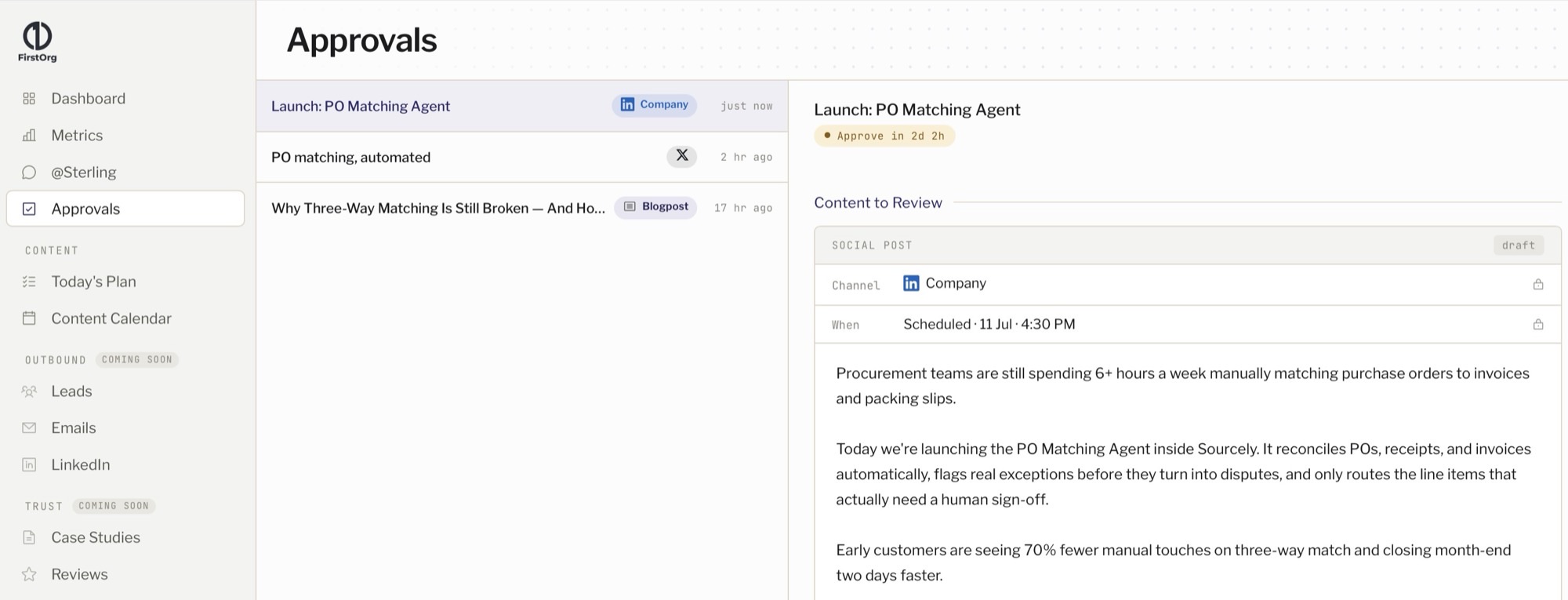
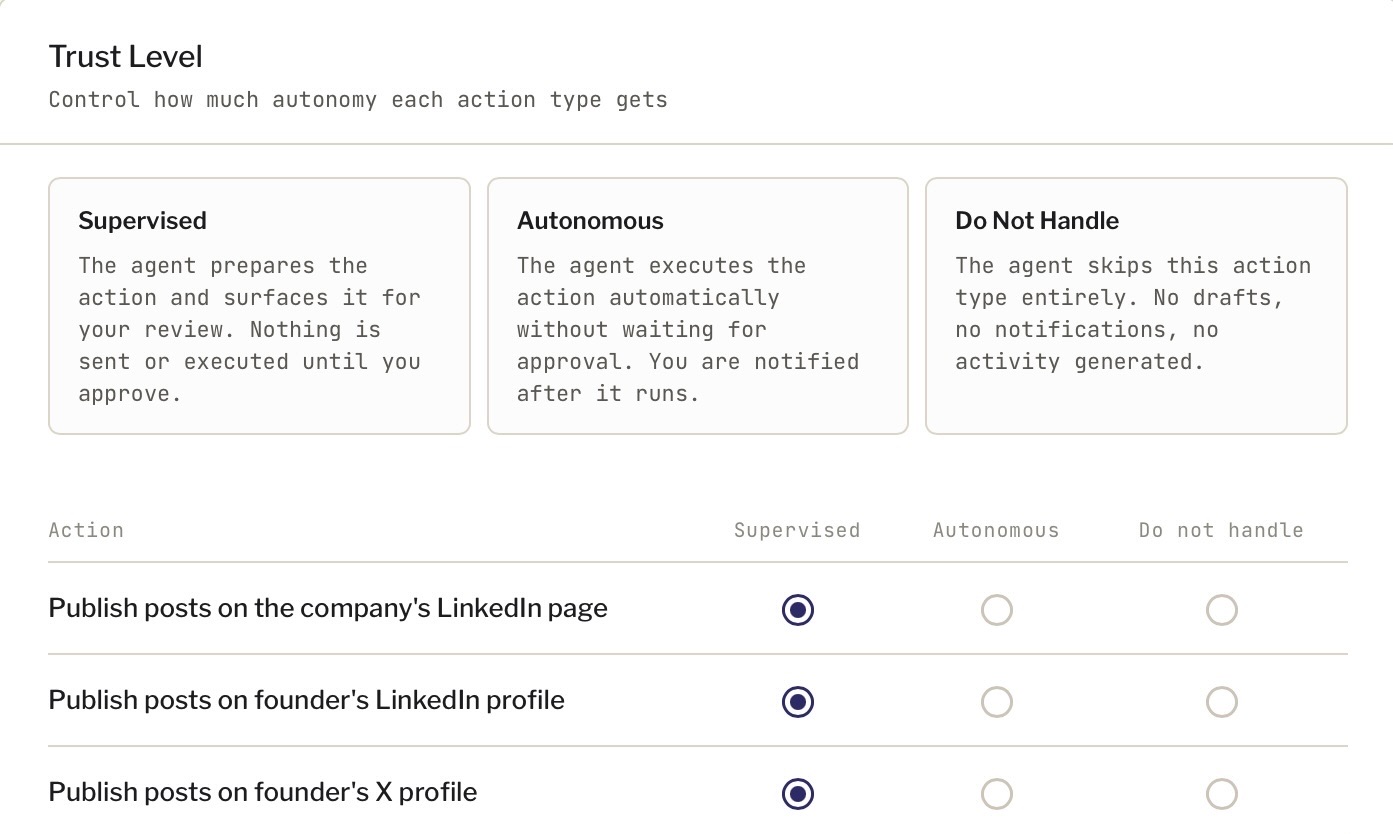
FirstOrg Approvals screen showing a LinkedIn post queued for review, with its content, channel, and schedule visible before it goes live FirstOrg Trust Level screen showing per-action controls set to Supervised, Autonomous, or Do Not Handle for publishing on LinkedIn, X, and the blog
FirstOrg Trust Level screen showing per-action controls set to Supervised, Autonomous, or Do Not Handle for publishing on LinkedIn, X, and the blog
FirstOrg Approvals screen showing a LinkedIn post queued for review, with its content, channel, and schedule visible before it goes live

No AI Slop.
Just Your Unique Voice.

Deep Lattice is the memory under every agent in the engine. It stores your company, your market, how you write, and everything the engine has learned working for you — so every draft comes out sounding like you on a good day.

How Deep Lattice shapes every draft Company profile, product details, market and competitors, ideal customer profile, past posts, writing samples, and weekly reviews all feed Deep Lattice, which produces content in your voice, on-topic posts, and an approach that evolves over time. DEEP LATTICE Company Profile Product Details Market & Competitors Ideal Customer Profile Past Posts Writing Samples Weekly Reviews Content Voice Topical Posts Evolves Over Time How Deep Lattice shapes every draft Company profile, market and competitors, past posts, weekly reviews, product details, ideal customer profile, and writing samples all feed Deep Lattice, which produces content in your voice, on-topic posts, and an approach that evolves over time. DEEP LATTICE Company Profile Market & Competitors Past Posts Weekly Reviews Product Details Ideal Customer Profile Writing Samples Content Voice Topical Posts Evolves Over Time Explore Deep Lattice

All The Metrics
You'll Ever Need

Publishing cadence, streaks, channel mix, pillar coverage — the engine keeps score, so you always know what shipped and what it's doing for you.

How to read content ROI as a founder
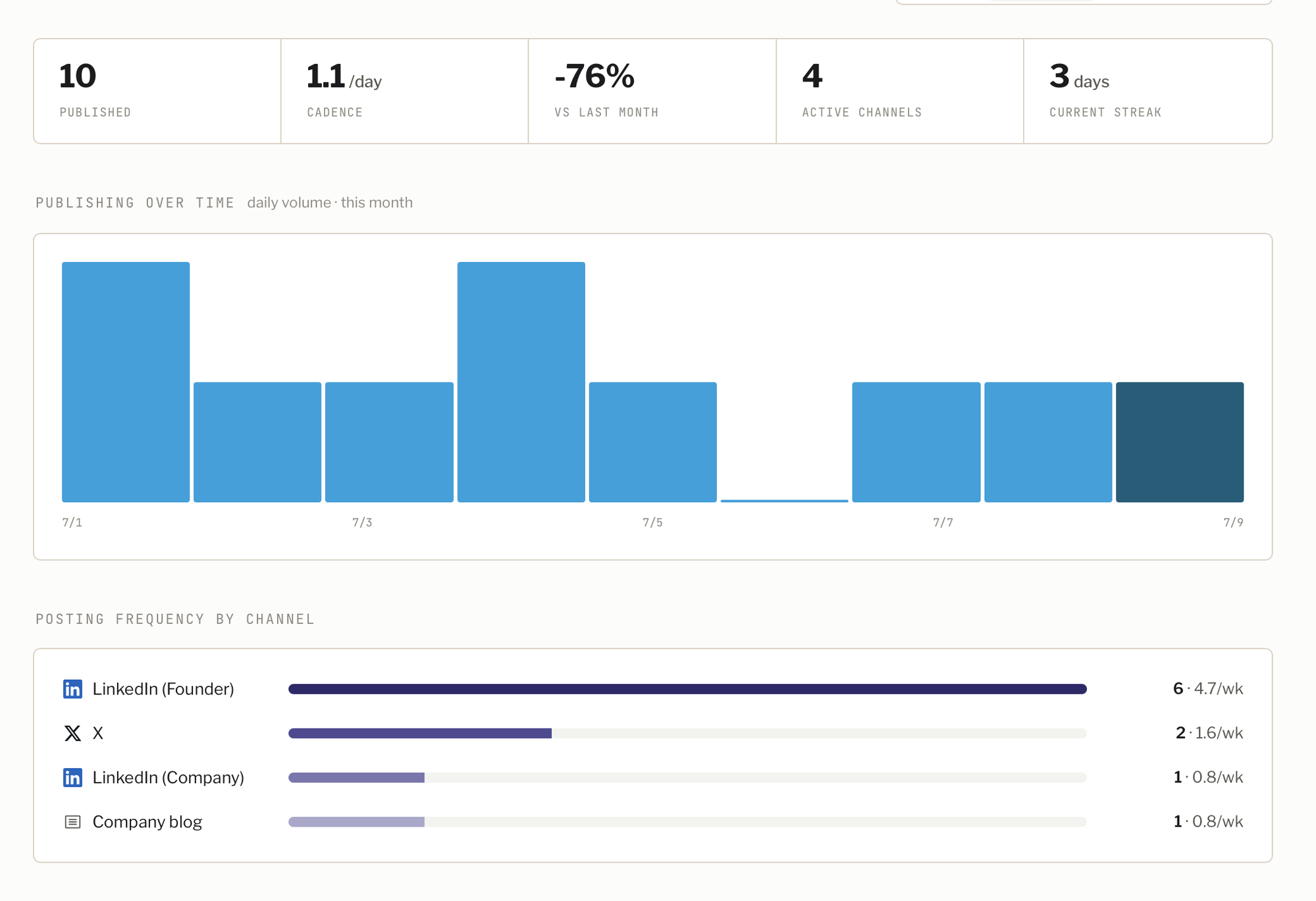
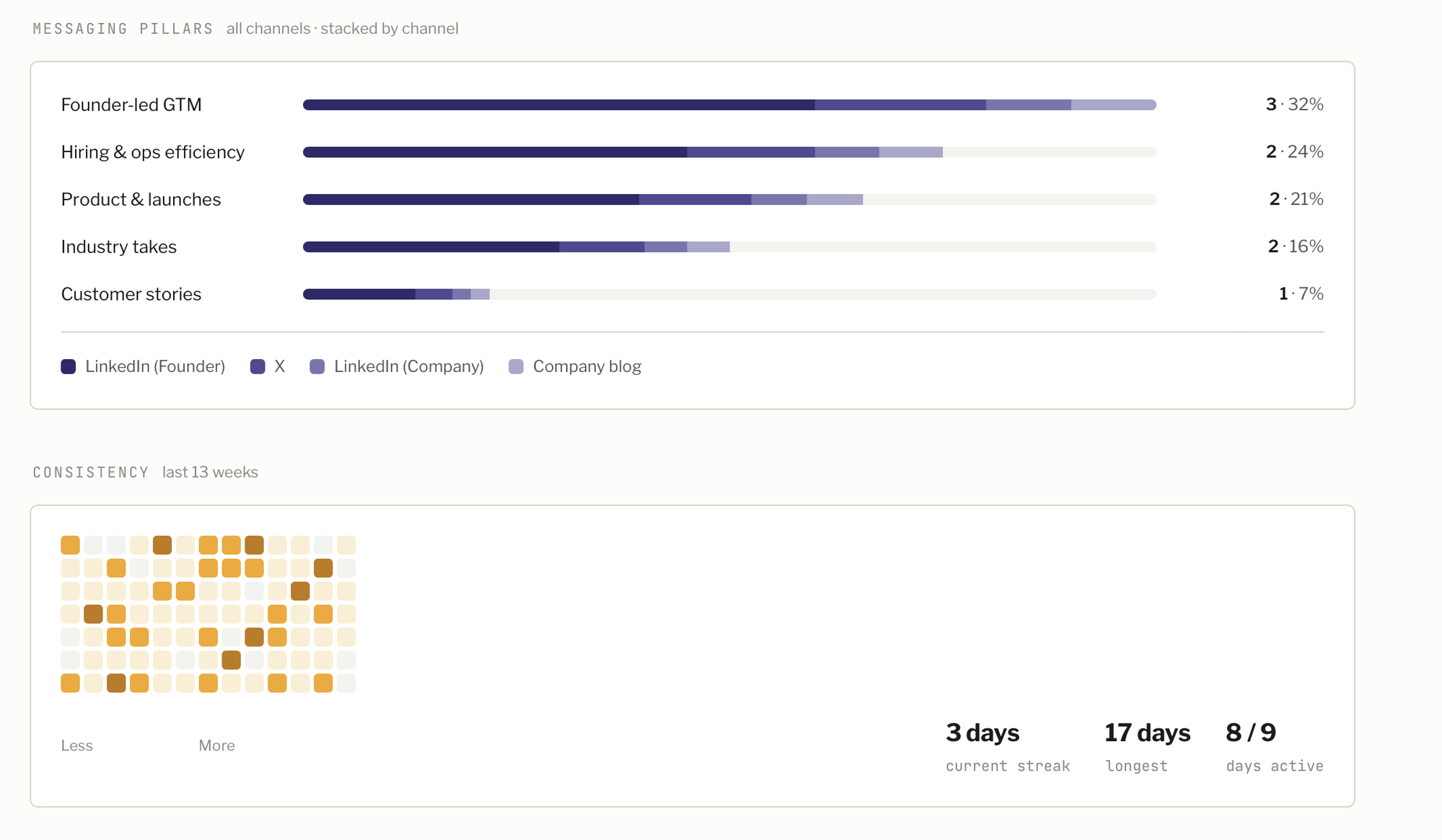
Publishing metrics dashboard showing 10 posts published, a cadence of 1.1/day, active channels, current streak, daily publishing volume this month, and posting frequency by channel Messaging pillars breakdown by channel and a 13-week publishing consistency heatmap
Publishing metrics dashboard showing 10 posts published, a cadence of 1.1/day, active channels, current streak, daily publishing volume this month, and posting frequency by channel
Messaging pillars breakdown by channel and a 13-week publishing consistency heatmap

Where This
Is Heading.

Content is live today. The same engine — same memory, same controls — is growing into the rest of the B2B stack, so you never go back to bolting thirty tools together.

Why fewer tools beats more

Content

  • SEO
  • GEO
  • Social
Live

Outbound

  • Prospecting
  • Email
  • LinkedIn
Coming Soon

Trust

  • Case Studies
  • Reviews
Coming Soon

Revenue

  • AI SDR
Coming Soon

Not sure it fits your stage or team? Is this for me? →

Questions, answered.

What exactly is the Content Engine?

One system that runs your whole content operation: it builds your strategy, plans a calendar, writes every post, and publishes to your channels — then reads the results and repeats, seven days a week.

How do strategy, LinkedIn, and SEO fit together?

They're stations on one loop. Your strategy sets the pillars and topics; the LinkedIn and Search specialists write and publish against that same plan, so every channel stays coordinated instead of drifting into its own voice.

How fast can I actually go live?

A few minutes — onboarding builds your company profile, strategy, cadence, and your first set of posts in one pass. From there the engine runs without needing more input from you. Watch the ten-minute walkthrough →

Do I have to approve everything, or can it run on its own?

Every task type carries its own trust level. On Supervised, a draft waits in your queue and publishes after 24 hours if you haven't acted; Autonomous skips the wait. See Approvals & Trust →

Will the content actually sound like us?

Yes — Deep Lattice stores your voice, positioning, and writing samples, and every agent in the loop drafts against that same memory, so nothing ships needing a rewrite to sound like you. How the voice layer works →

How does it actually publish to my channels?

FirstOrg connects to LinkedIn and X through Buffer — encrypted, no credentials stored — and publishes on schedule. Blog articles are written ready to ship; you publish those to your own site yourself today.

Is this better than hiring an agency, or doing it myself?

It depends on which failure mode you can afford — agencies buy polish but lose your voice, DIY keeps the voice but rarely survives your calendar. The decision framework →

Does the engine learn from how posts perform, or is the strategy static?

It's a loop, not one-and-done — results feed back into strategy every week, so what's working shapes the next round of topics, calendar, and drafts automatically.

What's my actual time commitment once it's running?

One step: review your approval queue whenever suits you — or grant trusted channels autonomy and just check in on what published.

More customers. On autopilot.

FirstOrg wins you customers with high-quality content that runs itself.

Join Waitlist →